Education
.png)
The best proposals don't just inform. They answer the questions clients haven't asked yet. That's the difference between a proposal that generates a reply and one that generates a booking.


Travel advisors are managing more than their clients realize. Behind every beautifully presented trip is a workflow: inquiry to quote, quote to clarification, clarification to forms, forms to payment. Every handoff is a chance to keep the momentum going or let it slip.
A modern travel proposal isn't just a document describing the trip. It's where the client relationship either moves forward or stalls.
Here's the encouraging part: most proposals stall for the same reason, and it almost always comes down to how the proposal was set up. And that's something you can actually control.
Picture this: a client asks to swap one hotel for another with an ocean view. You open the PDF, make the change, and suddenly the layout breaks. The pricing table shifts. The header needs resizing. Fonts don't match after you paste in the new description. What should have taken five minutes stretches into two hours of reformatting, and you still have three other clients waiting on quotes.
That's the real cost of a standalone proposal.
When your proposal has to be formatted in a separate design tool and sits apart from your forms, approvals, and payment process, even a minor update can turn into a coordination headache. You stop guiding clients toward a decision and start managing versions, attachments, and follow-up threads. Hotel comparisons scatter across email chains. Credit card authorization forms go out as a separate follow-up. Travel insurance selections arrive in yet another message. Terms and conditions get chased after the fact.
The issue isn't your effort or your organization. It's the separation. When each step in the client journey lives in a different place, every small update multiplies the work required to keep everything moving.

The best proposals don't just inform. They answer the questions clients haven't asked yet. That's the difference between a proposal that generates a reply and one that generates a booking.
Here's what advisors who close quickly consistently include:
When these elements come together, the proposal becomes a decision tool, not a conversation starter.
Most of the friction in a traditional proposal workflow comes from the format itself. A PDF is a document. A modern digital proposal is an experience, and the difference shows up in how clients engage with it.
Here’s the difference:
The PDF workflow asks clients to do work. Download, read, reply, wait. A digital proposal workflow brings everything together: the trip, the options, the forms, the decision, all in one place and in one visit.
Travefy was built by people who understand travel advisor workflow. Not just the software side of it, but the actual craft of planning and presenting a trip. That understanding shapes how proposals work inside the platform.
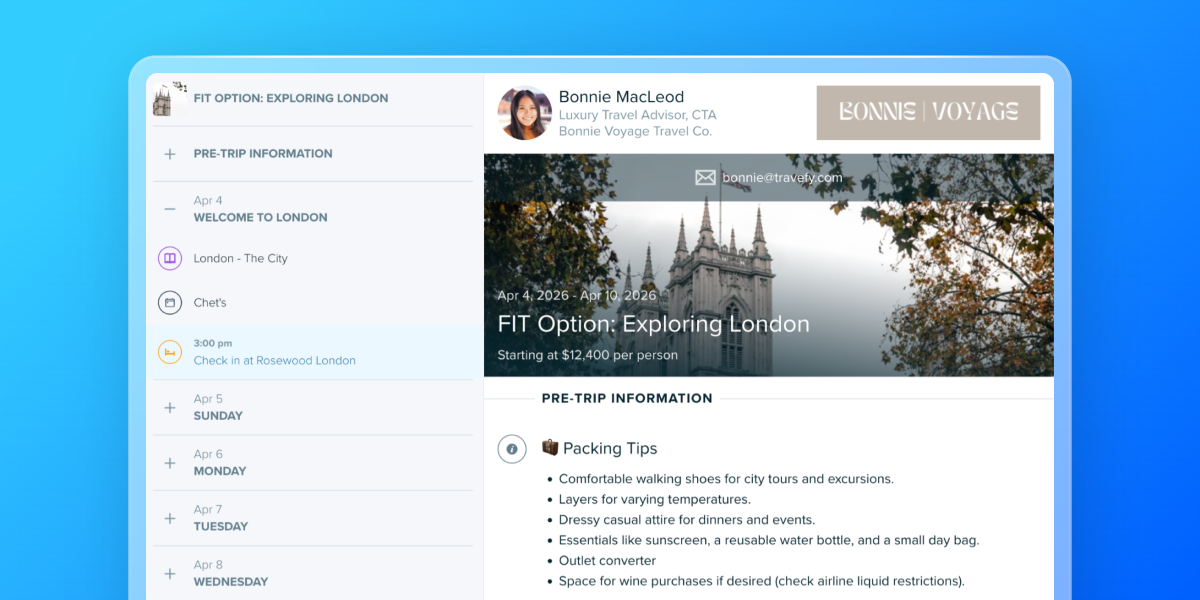
The first thing a client sees sets the tone for everything that follows. Travefy proposals are professionally designed, fully branded with your agency's look, and structured to present your work the way it deserves to be presented. No one should be able to tell you sent it in under an hour. Even if you did.
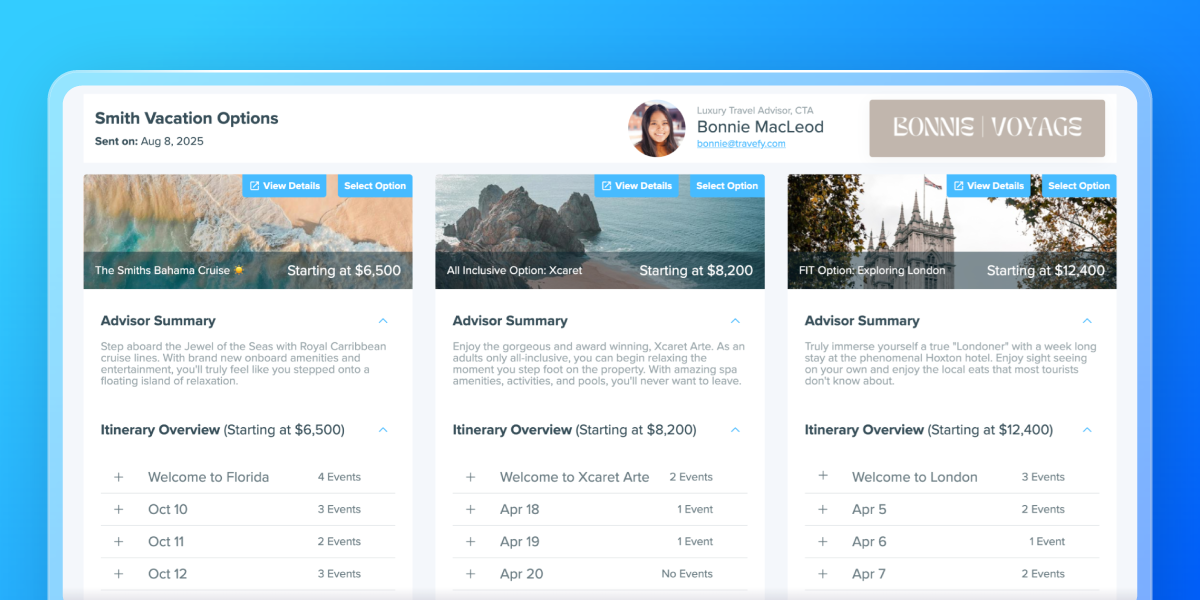
Clients shouldn't have to juggle proposals across multiple emails and spreadsheets. Travefy lets you present up to three options side-by-side in one clean view, and you can even share event-level options within a trip for clients to choose from. Perfect for hotels, cabin types, and trip insurance options.
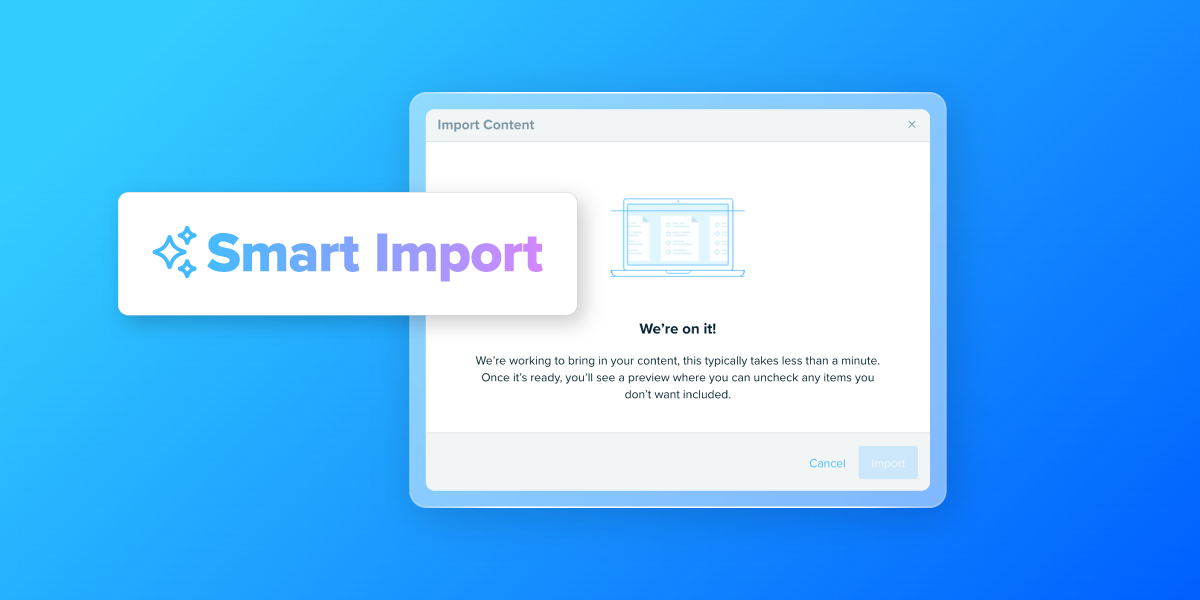
AI is changing the way travel advisors work, and Travefy is keeping pace. With Smart Import, you can pull in bookings, photos, and trip details in seconds rather than typing them out by hand. The results speak for themselves: in just one month, this feature alone saved the Travefy community over 17,000 hours of manual data entry. That's time you can put back into actually planning the trip.
This is where most of the unnecessary follow-up disappears. Attach a credit card authorization form, client profile form, and terms and conditions directly within the proposal itself. No separate sends. No chasing. Everything a client needs to complete sits in the same place as the trip they're about to book.
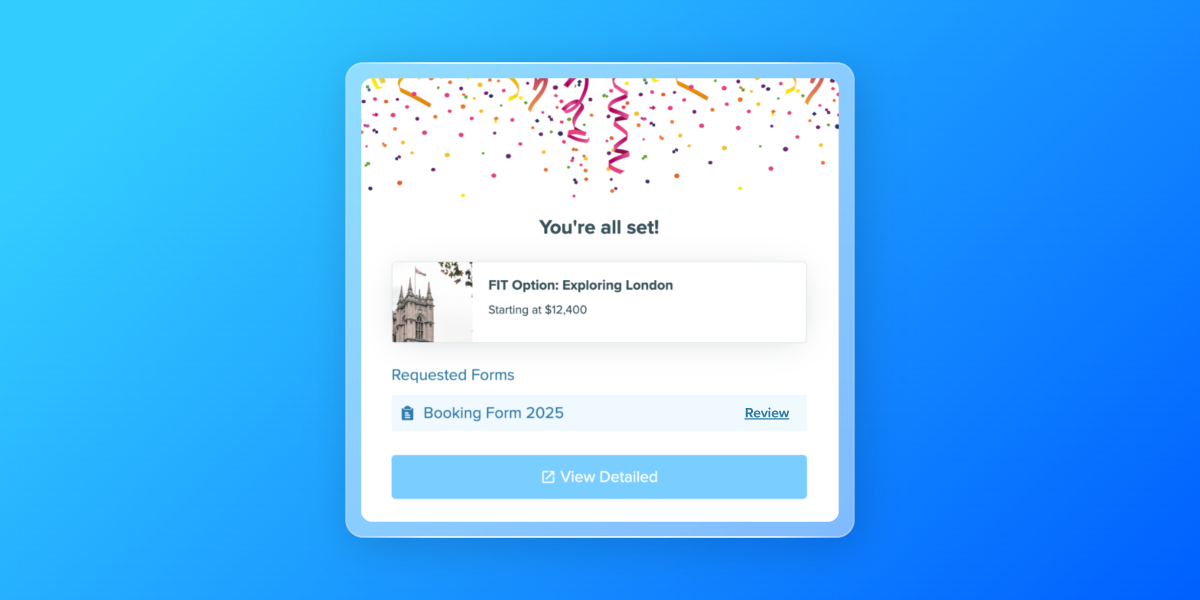
The best way to understand what a modern proposal looks like in practice is to see how advisors are actually using it. The example below shows how Travefy's proposal tool works across different trip types and client experiences.
Morgan walks through how she uses Travefy's Decisions feature to present multiple hotel or itinerary options inside a single proposal, letting clients compare and choose without a single follow-up email.
Below is a real Travefy proposal that guides a client through their options and makes the next step clear and simple. Click through it to see how the decision flow works.
A travel proposal isn't just how you sell a trip. It's a statement of how you run your business. Clients notice whether the experience feels polished or patched together. A proposal that anticipates their questions, lays out their options clearly, and tells them exactly what to do builds the kind of trust that brings them back.
But the proposal is one step in a longer journey. Inquiry to proposal to booking to itinerary to post-trip follow-up: each handoff is a chance to elevate the client experience or lose the thread. An all-in-one advisor platform creates continuity across all of it, so your clients feel the care at every stage, not just the moment you send the pitch.
Your proposal starts the momentum. Your system sustains it.
Ready to save time and create your proposal? Start Your Free Trial.
Yes! Travefy lets you track when a client opens their proposal, so you always know the best moment to follow up. You can check the link status directly from your trip — it'll show you whether the proposal has been opened and when. For full details on how to find this, check out the documentation here.
The most effective travel proposals include a clear trip overview, transparent pricing, side-by-side option comparisons, embedded forms, and explicit next steps.
Absolutely. With Travefy, proposals are live digital links rather than static attachments, which means any changes you make are reflected instantly for the client. Whether you're swapping a hotel, adjusting pricing, or adding options, updates are immediate, ensuring your proposal always stays current.
Travefy's Smart Import feature uses AI to pull in bookings, photos, and trip details to build dynamic proposals in seconds. In just one month, Smart Import saved the Travefy community over 17,000 hours of manual data entry.
Join thousands of advisors who get our monthly newsletter filled with product releases, upcoming events, and industry highlights. Delivered straight to your inbox.